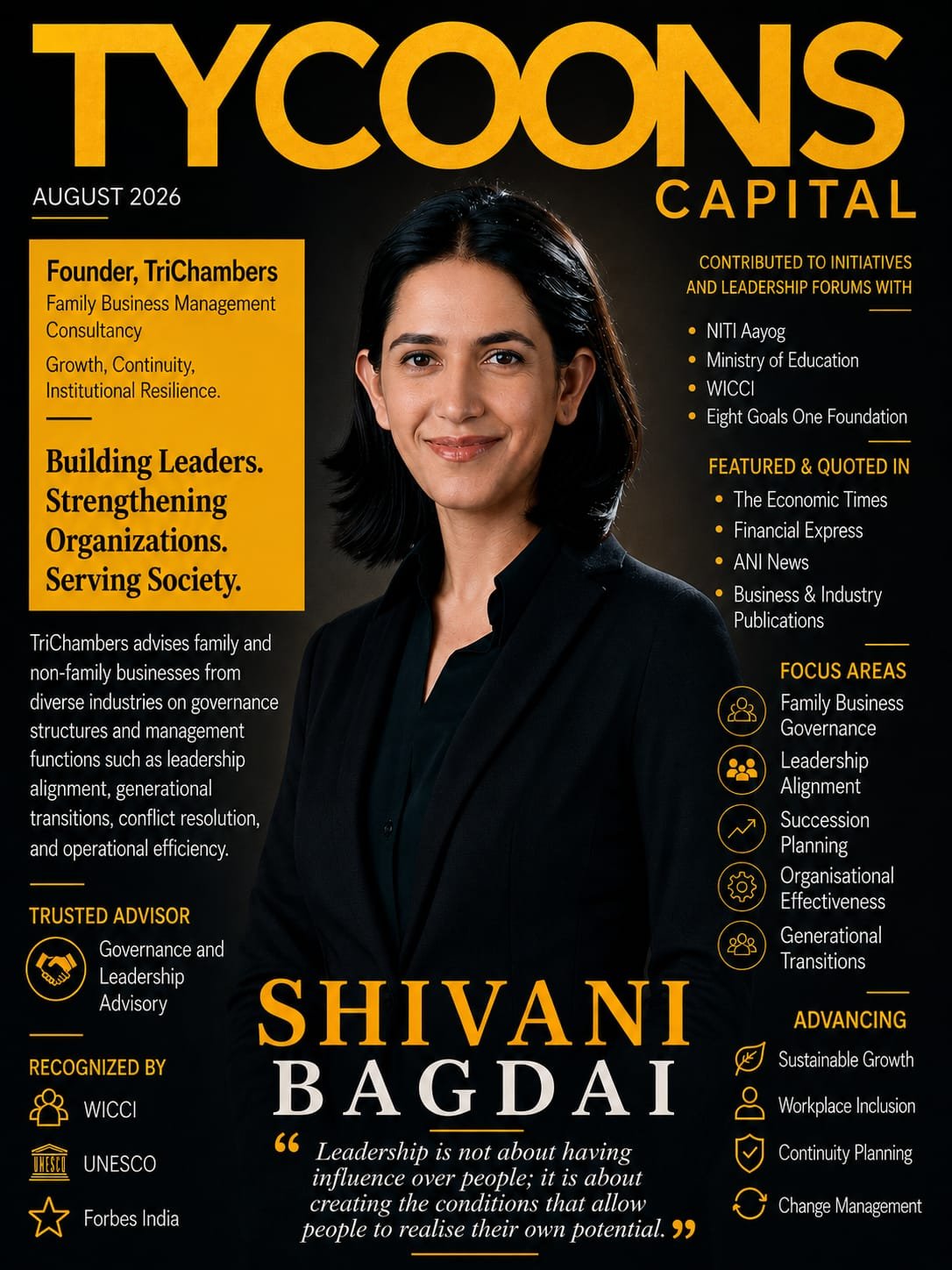
Shivani Bagdai works in a part of leadership that often receives attention only when it fails. Governance, succession, alignment, and conflict resolution may not command the immediate visibility of growth or expansion, yet they often determine whether an institution can endure beyond its strongest individual. As a governance and leadership strategist and the Founder of TriChambers, Shivani has built her work around strengthening these deeper foundations.
Through TriChambers, she advises family businesses and organisations on governance, succession planning, leadership alignment, conflict resolution, and sustainable growth. Her approach recognises that long-term continuity cannot rest on ambition alone. It requires clear structures, informed decisions, and the ability to navigate the tensions that emerge when leadership, legacy, and growth intersect.
Building Institutions Beyond Individuals
Family businesses face a challenge that is both deeply personal and profoundly strategic: how to preserve continuity while preparing for change. Shivani’s work addresses this intersection, helping organisations think beyond immediate leadership and towards the systems required for generational resilience.
Her Family Business Excellence Series extends this conversation into the wider business ecosystem. The initiative promotes thought leadership around business continuity and generational leadership, placing succession and institutional preparedness at the centre of discussions about sustainable enterprise.
Bringing Fairness into Decision-Making
A significant dimension of Shivani’s work is her contribution to the F.A.I.R. Methodology, which she co-developed in collaboration with UNESCO and global policymakers. The internationally recognised methodology advocates fair and informed decision-making, reinforcing her belief that governance is not merely about compliance or control.
At its best, governance creates the conditions for better judgement. It brings clarity to competing interests, gives structure to difficult decisions, and helps institutions remain accountable to the people they serve. This principle runs through Shivani’s work across business, policy, and leadership.
Leadership with a Wider Public Purpose
Her engagements span institutions and initiatives including NITI Aayog, the Ministry of Education, WICCI, and Eight Goals One Foundation. Across these platforms, she has contributed to conversations around ethical leadership, women’s empowerment, workplace inclusion, and institutional development.
The breadth of this work reflects a view of leadership that extends beyond the boardroom. For Shivani, resilient institutions are shaped as much by values and inclusion as by strategy. Sustainable leadership requires organisations to examine not only what they achieve, but also how decisions are made and whose voices are heard.
Recognition for a Governance-Driven Approach
Shivani’s work has been featured by The Economic Times, Financial Express, and ANI News. She has also received recognition from Forbes India and the Women’s Economic Forum. Yet the larger significance of her journey lies in the consistency of the questions she continues to address.
How does a family business outlive a generation? How can leadership remain aligned when interests diverge? How can institutions grow without weakening the principles that give them legitimacy?
These are not questions with easy answers. They require patience, structure, and the willingness to address difficult issues before they become crises.
The Work Behind Enduring Leadership
In an age increasingly drawn to visible leadership, Shivani Bagdai’s work draws attention to the less visible architecture behind institutions that last. Governance may operate quietly, but its consequences are felt everywhere—in transitions handled well, conflicts resolved before they deepen, leaders prepared before responsibility changes hands, and organisations equipped to grow without losing their centre.
Through TriChambers, her thought leadership, and her wider institutional engagements, Shivani continues to advance a simple but consequential idea: enduring leadership is not built only by those who take institutions forward. It is also shaped by those who build the structures that allow them to remain strong when the people, circumstances, and generations around them change.